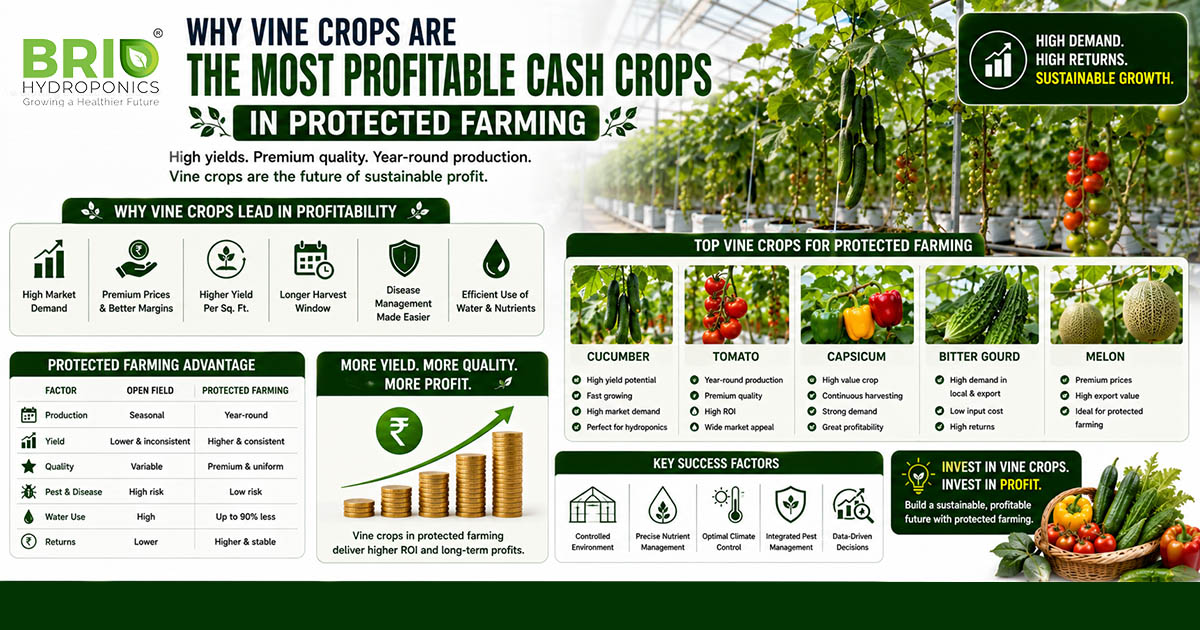
A complete guide to high ROI farming methods in India using polyhouse, hydroponics, and climate controlled systems.
If you ask any experienced protected cultivation farmer in India which crop category has given them the most consistent and highest returns, the answer is almost always the same: vine crops.
Cherry tomatoes, cucumbers, capsicum, bottle gourd, bitter gourd, and their cousins have become the backbone of commercial polyhouse and hydroponic greenhouse farming across India. This guide explains exactly why vine crops dominate the profitability charts in protected farming, and what you need toknow to make the most of them on your own setup.
India's agricultural sector is shifting. Open-field farming is becoming increasingly unpredictable due to erratic monsoons, rising input costs, and shrinking market margins. At the same time, protected cultivation is showing farmers a different path: one where the environment is controlled, crop quality is consistent, and buyers are willing to pay a premium. And within protected cultivation, vine crops sit right at the top of the profitability pyramid.
Whether you are planning a polyhouse setup in India, setting up a commercial hydroponic farming operation, or exploring climate controlled farming for the first time, understanding why vine crops deliver the best return on investment will help you make smarter decisions from day one.
What Are Vine Crops and Why Do They Belong in Protected Farming?
Vine crops are climbing or trailing plants that produce fruits along sprawling stems. In the context of protected cultivation and high ROI farming methods in India, the most commercially relevant vine crops include:
|
Vine Crop |
System Best Suited For |
Primary Market |
|
Cherry Tomato |
Dutch Bucket Hydroponics / Polyhouse |
5-star hotels, premium retail, exports |
|
Coloured Capsicum |
Dutch Bucket / NFT Hydroponics |
Modern retail, restaurants, exports |
|
Cucumber (English) |
Dutch Bucket / Climate Controlled GH |
Hotels, supermarkets, HoReCa |
|
Bottle Gourd |
Polyhouse / Low-Cost Trellised |
Wholesale, retail, local markets |
|
Bitter Gourd |
Polyhouse Trellised Setup |
Wholesale, Ayurvedic processors |
|
Zucchini |
Dutch Bucket / Polyhouse |
Premium retail, cloud kitchens |
|
Muskmelon / Melon |
Polyhouse Trellised / Drip |
Premium fruit retail, exports |
|
Strawberry |
NFT / Dutch Bucket Hydroponics |
Direct-to-consumer, premium retail |
What all these crops share is a growth habit that suits vertical production systems. When trained on trellises inside a polyhouse or hydroponic greenhouse farming setup, vine crops use vertical space efficiently, produce over long harvest windows, and deliver far more value per square foot than most annual field crops.
The Six Reasons Vine Crops Deliver the Highest ROI in Protected Farming
When farmers and agri-investors evaluate high ROI farming methods in India , vine crops consistently come out ahead for six interconnected reasons. Understanding each one helps you design a farm and a sales strategy that captures the full potential of this crop category.
1. Extended Harvest Windows Multiply Your Annual Revenue
One of the most important profitability drivers in protected cultivation is the length of the harvest window. Unlike a leafy green crop that is harvested in 30 to 45 days and then replanted, a vine crop like cherry tomato or cucumber continues producing for 6 to 9 months in a well-managed polyhouse or hydroponic system.
Each plant is an ongoing revenue source. Once the first fruits set, you are harvesting every 3 to 5 days from the same plant for months. This dramatically reduces the replanting labour and downtime costs that shorter-cycle crops carry, and it means your farm is generating income continuously rather than in batch cycles.
Farmer Insight
In a well-managed polyhouse cherry tomato crop, a single planting can be harvested for up to 9 months if temperature and nutrition are managed well. Compare that to spinach, which is in and out in 35 days. The continuous harvest model of vine crops is a major reason why commercial farmers prefer them for maximum ROI.
2. Premium Market Positioning That Commands Better Prices
Most vine crops grown in climate controlled farming environments produce fruit with consistent size, colour, and flavour that is distinctly superior to open-field produce. This quality consistency is what premium buyers pay for.
Cherry tomatoes grown in a hydroponic greenhouse farming setup sell at significantly higher prices than commodity tomatoes in the mandi. English cucumbers from a climate controlled polyhouse are sold to five-star hotels at prices that open-field cucumbers cannot match. Coloured capsicum from a polyhouse setup in India commands premium rates in modern retail chains that demand consistent quality year-round.
The quality premium for vine crops from protected cultivation is real, consistent, and well established across Indian urban markets. Farmers who invest in proper post-harvest handling and packaging can consistently achieve price realisations that are 30 to 60 percent better than what open-field growers receive for the same crop.
3. High Yield Per Square Foot Through Vertical Growing
In open-field farming, vine crops sprawl across the ground and are labour-intensive to manage. In protected cultivation , they are trained vertically on trellis wires inside the polyhouse or greenhouse, which transforms the space equation entirely.
A standard polyhouse can support high-density planting of vine crops because the vertical structure allows you to pack more plants into the same floor area. In commercial hydroponic farming systems using Dutch bucket setups for cherry tomatoes, the yield per square meter can be several times what an open-field crop achieves in the same period. This multiplier effect on productivity per unit of land is one of the core reasons vine crops deliver superior ROI for protected environment investments.
4. Year-Round Supply Capability Gives You Market Leverage
One of the biggest challenges for wholesale buyers, hotel procurement teams, and modern retail chains in India is securing consistent year-round supply of quality vine crops. Open-field growers can only supply seasonally, and quality varies dramatically across seasons.
A farmer running a climate controlled farming setup can supply cherry tomatoes, cucumbers, or capsicum 52 weeks a year with consistent quality. This year-round supply capability is not just a convenience for buyers; it is leverage for the farmer. When you can supply what buyers need when they need it, you negotiate from a position of strength and secure longer-term supply contracts that protect your revenue.
Farmers who have established annual supply agreements with hotel chains or modern retail groups report significantly more stable incomes than those selling through spot markets, because the contract price is set in advance and protects them from price volatility.
5. Lower Pest Pressure Reduces Input Costs and Crop Loss
Vine crops in open fields are heavily targeted by a wide range of pests and fungal diseases. In a properly managed polyhouse setup in India with insect-proof netting, physical pest entry is dramatically reduced. In a hydroponic greenhouse farming system with clean nutrient management, many soil-borne diseases simply do not exist.
This reduction in pest and disease pressure has a direct impact on both input costs (less pesticide usage) and crop loss (fewer plants failing or producing unmarketable fruit). For high-value vine crops like cherry tomatoes and coloured capsicum, even a small reduction in crop loss percentage translates into significant rupee value because each kilogram carries a premium price.
6. Strong and Growing Demand Across Multiple Buyer Channels
The demand side of the equation is equally important in understanding why vine crops are the top choice for high ROI farming methods in India . India's urban food market is growing, and within it, the demand for premium, fresh, consistently available vegetables is expanding rapidly across several buyer channels:
Key Buyer Channels for Protected Cultivation Vine Crops
- Five-star and four-star hotels needing consistent quality for restaurant kitchens year-round
- Modern retail chains including hypermarkets and premium supermarkets in Tier 1 and Tier 2 cities
- Cloud kitchens and food delivery brands requiring traceable, quality-certified fresh produce
- Meal kit and subscription box companies serving urban health-conscious consumers
- Institutional caterers serving corporate offices, hospitals, and educational institutions
- Direct-to-consumer models including farm subscription boxes and organic home delivery
- Food processing companies requiring consistent quality for sauces, pickles, and ready-to-eat products
- Export buyers looking for Indian-grown premium vegetables for Gulf and European markets
Vine Crops in Polyhouse vs Hydroponic Systems: Which Works Better?
A question that comes up frequently among farmers considering vine crops is whether to grow them in a soil-based polyhouse setup in India or in a commercial hydroponic farming system . The honest answer is that both work, and both have delivered profitable results across India. The right choice depends on your budget, technical comfort level, and target market.
|
Factor |
Polyhouse (Soil-Based) |
Hydroponic System |
|
Setup Cost |
Lower initial investment |
Higher upfront cost |
|
Yield Per Plant |
Good; improved vs open field |
Higher; better nutrient delivery |
|
Water Usage |
Moderate savings with drip irrigation |
Up to 90% less water than soil |
|
Crop Cycle Control |
Good with proper management |
Excellent; precise control |
|
Input Costs |
Fertiliser and soil management required |
Nutrient solution; no soil inputs |
|
Skill Requirement |
Familiar to experienced farmers |
Requires training on pH, EC, nutrition |
|
Best For |
Farmers transitioning from open field |
Premium market, urban agri-entrepreneurs |
|
Disease Risk |
Soil-borne diseases possible |
Virtually no soil-borne disease risk |
|
Subsidy Eligibility |
Well covered under MIDH and state schemes |
Partial; polyhouse structure covered |
Many successful commercial growers in India start with a soil-based polyhouse for vine crops and then upgrade one section at a time to a hydroponic Dutch bucket system. This phased approach allows them to generate revenue from the polyhouse investment while building technical expertise in hydroponics gradually, without betting the entire capital on a system they are still learning.
Climate Controlled Farming: The Key to Vine Crop Quality Consistency
Of all the factors that influence vine crop profitability in protected settings, climate controlled farming has the most direct impact on the quality premium you can command. Vine crops are sensitive to temperature and humidity fluctuations. A cherry tomato plant that experiences consistent optimal day and night temperatures will produce fruit that is more uniformly coloured, correctly sized, and better flavoured than one that experiences stress from heat spikes or cold nights.
In India, where summer temperatures in many states can push well above 40 degrees Celsius and winters in northern regions can stress tropical crops, a climate controlled greenhouse is not a luxury for serious commercial vine crop production. It is the infrastructure that protects your quality premium and therefore your price realisation.
What Climate Control Does for Vine Crop Quality
- Maintains optimal temperature for fruit set and development, reducing fruit drop
- Controls humidity levels to prevent fungal disease like powdery mildew and botrytis
- Protects against heat stress that causes blossom drop and misshapen fruit
- Allows year-round production in regions with extreme winters or summers
- Enables tighter control over ripening uniformity, which premium buyers require
- Reduces the risk of cracking in tomatoes caused by irregular watering and temperature swings
What Does a Commercial Vine Crop Setup Require?
Planning a commercial vine crop operation in protected cultivation requires thinking through several interconnected elements. Here is what a well-designed setup typically includes:
Structure
A naturally ventilated or fan-and-pad polyhouse is the standard starting point for most vine crop operations in India. For higher-value crops like cherry tomatoes and coloured capsicum targeting premium markets, a hi-tech polyhouse with automated ventilation and shade management is preferable. Glass or polycarbonate greenhouses offer the best environment control but at a higher capital cost.
Trellis and Training System
Vine crops in protected settings are grown on a vertical trellis system using GI wires, clips, and twine or monofilament. The trellis height inside the polyhouse typically allows plants to grow 3 to 4 metres before lowering techniques are used to extend the productive season of each plant. Proper training of the vine is one of the most labour-intensive but also most impactful management practices for maximising yield.
Irrigation and Nutrition
For soil-based polyhouse vine crops, drip irrigation with fertigatation is standard. For hydroponic setups , Dutch bucket systems filled with cocopeat or rockwool are the most widely used configuration for vine crops in India. Precise EC and pH management of the nutrient solution is critical for achieving the fruit quality that premium buyers expect.
Post-Harvest Infrastructure
The value of premium vine crops can be significantly eroded between harvest and delivery if post-harvest management is poor. For cherry tomatoes, cucumbers, and capsicum targeting hotel and modern retail buyers, pre-cooling facilities, grading equipment, food-grade packaging, and reliable cold-chain logistics are essential investments that protect the premium price you have worked to achieve in the field.
Building Your Market Before Your First Harvest
The most consistently profitable vine crop farmers in India share one habit: they secure their buyers before they plant. Investing in a high ROI farming methods in India setup without having confirmed offtake agreements is the single biggest risk in commercial protected cultivation. The infrastructure costs are significant, and selling premium vine crops through the mandi at commodity prices defeats the entire purpose of the investment.
How to Build Market Linkages Before Planting
- Visit hotel procurement managers in your nearest Tier 1 city and present a crop calendar and sample quality standards you plan to meet.
- Approach the fresh produce manager at premium supermarket chains. They are actively looking for reliable local suppliers who can deliver consistently.
- Connect with cloud kitchen aggregators and meal kit companies in your region. They value traceability and consistent quality over lowest price.
- Explore farmer-producer company structures with neighbouring farmers to build combined volume that large institutional buyers require.
- Consider a direct-to-consumer model through WhatsApp groups or platforms targeting health-conscious urban buyers in your nearest city.
Common Mistakes Vine Crop Farmers Make in Protected Farming
Understanding what goes wrong in vine crop protected farming is as valuable as knowing what to do right. Here are the most common mistakes that reduce profitability:
Mistakes to Avoid in Protected Vine Crop Farming
- Overcrowding plants to maximise early yield, which reduces airflow and creates disease pressure later in the season
- Neglecting proper training and pruning, which reduces fruit quality and makes the canopy difficult to manage
- Underestimating post-harvest investment: poor packaging and handling destroys the price premium at the delivery point
- Choosing crop varieties suited for open field rather than varieties bred for protected cultivation and premium markets
- Not managing the climate during transition seasons when day and night temperature swings are most extreme
- Selling through the mandi because no buyer relationships were established before harvest, forcing commodity pricing
- Skipping water quality testing before setting up a hydroponic system, leading to nutrient deficiencies from the start
Want to Start a Commercial Vine Crop Farm in India?
Our protected cultivation experts help farmers and agri-entrepreneurs across India design polyhouse and hydroponic setups for high-value vine crops. From site planning to buyer linkage support, we guide you through every step of building a profitable protected farm.
Get a FREE Farm Design Consultation Today.
Serving Maharashtra, Karnataka, Gujarat, Telangana, Rajasthan, Punjab and more.
Frequently Asked Questions (FAQs)
Key questions about vine crops, protected cultivation, and high ROI farming in India, answered clearly.
Q: Why are vine crops considered the most profitable crops in protected cultivation?
Vine crops deliver superior ROI in protected cultivation for several reasons: they have long harvest windows of 6 to 9 months per planting, they produce premium quality fruit that commands higher market prices than open-field produce, they can be grown vertically to maximise yield per square foot, and they can be supplied year-round to buyers who will pay a consistent premium for reliable supply. Together these factors make vine crops the top choice among commercial polyhouse and hydroponic farmers in India.
Q: Which vine crop gives the best ROI in a polyhouse setup in India?
Cherry tomatoes and coloured capsicum consistently deliver among the highest returns per square foot in a polyhouse setup in India, particularly when sold to premium buyers like hotels, supermarkets, and direct consumers. Cherry tomatoes have the additional advantage of a very long harvest window and strong demand across multiple buyer channels. English cucumbers and muskmelons are also excellent choices for premium market-linked polyhouse operations.
Q: Can vine crops be grown profitably in a commercial hydroponic farming setup?
Yes, vine crops are among the best suited crops for commercial hydroponic farming using Dutch bucket systems. Cherry tomatoes, coloured capsicum, and cucumbers thrive in Dutch bucket setups with cocopeat or rockwool growing media. The precise nutrient control of hydroponics results in more uniform fruit quality compared to soil-based growing, which is important for premium buyers. Many successful hydroponic operations in India focus specifically on vine crops for this reason.
Q: How does climate controlled farming improve vine crop profitability?
Climate controlled farming improves vine crop profitability in three main ways. First, it protects against temperature extremes that cause blossom drop, fruit deformation, and reduced yields. Second, it enables year-round production that allows the farmer to supply buyers consistently and negotiate better prices. Third, it reduces disease pressure, which lowers pesticide costs and crop loss, directly improving margin per kilogram of produce sold.
Q: What is the ideal protected farming system for growing vine crops in India?
The ideal system depends on your budget and market target. For farmers transitioning from open-field cultivation, a hi-tech polyhouse with drip irrigation and fertigatation is the most practical starting point. For entrepreneurs targeting premium buyers like hotels and modern retail, a Dutch bucket hydroponic system inside a climate controlled greenhouse delivers the best quality and the highest price realisation. Many successful commercial farms in India use a combination: polyhouse structure with Dutch bucket hydroponics inside.
Q: How do I find buyers for vine crops from my protected farm?
Finding buyers for protected cultivation vine crops requires proactive outreach before your first harvest. Target hotel procurement managers, fresh produce buyers at supermarket chains, cloud kitchen operators, and meal kit companies in your nearest city. Approach them with your crop calendar, quality standards, and packaging plan. Joining a farmer producer company or cooperative helps smaller farms achieve the volume that large institutional buyers require. Direct-to-consumer sales through local WhatsApp groups and subscription models are also growing rapidly in Indian cities.
Q: Are there government subsidies available for vine crop farming in a polyhouse?
Yes. The polyhouse structure required for protected vine crop cultivation is eligible for subsidy under the Mission for Integrated Development of Horticulture (MIDH), the National Horticulture Mission, and various state horticulture department schemes. Drip irrigation for the farm may also be separately subsidised. It is important to apply before construction begins, as most schemes require prior approval. Contact your district horticulture officer or the nearest NABARD branch for scheme details applicable in your state.
Q: How long does it take to recover the investment in a vine crop protected farm?
The payback period for a vine crop protected farm in India depends on scale, system type, and market linkages. Well-managed operations with confirmed premium buyers typically see a return on their capital within three to five years. Farms that secure hotel or modern retail supply agreements before planting often achieve faster payback because their price realisation is significantly higher than spot market or mandi sales. The extended harvest window of vine crops also helps accelerate payback compared to short-cycle crops.