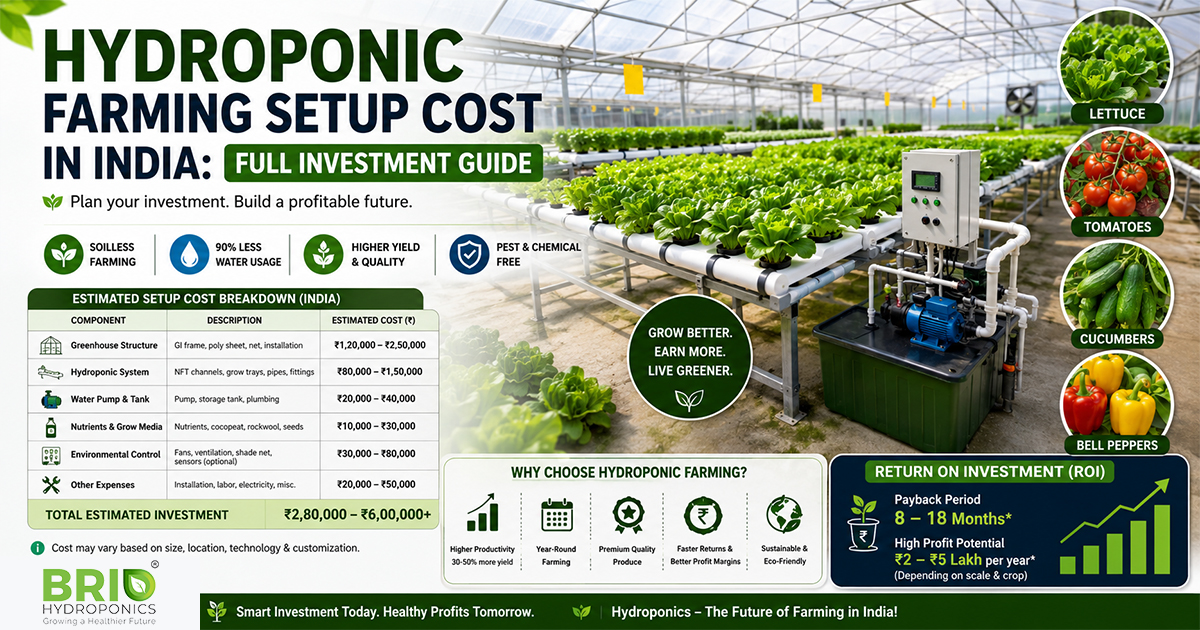
Thinking about starting a hydroponic farm in India but not sure where to begin with the costs? You are not alone. Every day, farmers and entrepreneurs across the country ask the same question: what is the real hydroponic farming setup cost in India, and is it worth the investment? This guide breaks it all down in simple, honest language so you can plan with clarity.
Hydroponic farming has moved well beyond being just an experiment in India. From rooftop setups in Mumbai to full-scale commercial greenhouses in Pune, Bangalore, and Hyderabad, the sector is growing fast. The reason is simple: hydroponics delivers higher yields, uses far less water, and allows farmers to grow year-round, independent of soil quality or monsoon patterns.
But before you invest, you need a clear picture of the hydroponic farm setup in India and how the costs are structured. This guide covers every major component so you can plan your investment realistically, whether you are starting small or going commercial.
Why Hydroponic Farming is Gaining Ground in India
India faces real agricultural challenges: shrinking arable land, water scarcity, unpredictable rainfall, and rising input costs. Hydroponic farming addresses most of these challenges head-on. Crops grown without soil, in a nutrient-rich water solution, consume up to 90% less water than conventional farming and produce yields that are often three to four times higher per square foot.
Add to this the fact that urban consumers are increasingly paying premium prices for fresh, pesticide-free vegetables and herbs, and you start to understand why the hydroponic farm setup in India is becoming one of the most talked-about agricultural investments right now.
Types of Hydroponic Systems and Their Cost Impact
Before we talk about hydroponics farm setup cost, it helps to understand what kind of system you are setting up, because the type of system is one of the biggest factors that determines your total investment.
1. NFT (Nutrient Film Technique)
This is one of the most popular systems in India for growing leafy greens like lettuce, spinach, and herbs. A thin film of nutrient solution flows continuously over the plant roots. NFT systems are relatively cost-efficient to build and maintain, making them a preferred choice for small hydroponic setup cost India calculations. They work well for beginners as well as commercial operations.
2. DWC (Deep Water Culture)
In DWC systems, plants are suspended in nutrient-rich water with their roots submerged. These are simple to build and popular for home setups and small commercial farms. The infrastructure cost is lower but managing water temperature and aeration requires attention, especially in hot Indian summers.
3. Dutch Bucket / Drip Systems
These are commonly used for fruiting crops like tomatoes, cucumbers, capsicum, and brinjal. Dutch bucket systems require more initial investment in piping, grow media, and irrigation controls, so they tend to push up the commercial hydroponic farming cost slightly compared to NFT systems.
4. Vertical Farming / Aeroponic Systems
These are the most sophisticated and capital-intensive setups, often used in controlled-environment agriculture for high-value crops. They are ideal if you are targeting high-end restaurant supply, export markets, or premium retail. The hydroponic project cost India for aeroponic or vertical farming setups is significantly higher but the returns per square foot are also much better.
What Goes Into the Hydroponic Farm Setup Cost in India
|
Cost Component |
What It Covers |
Scale Sensitivity |
|
Greenhouse / Structure |
Polyhouse, shade net, GI frame, or controlled environment building |
High |
|
Hydroponic Growing System |
NFT channels, DWC tanks, Dutch buckets, piping, fittings |
High |
|
Nutrient Solution Setup |
Nutrient tanks, dosing pumps, EC/pH meters, fertilisers |
Medium |
|
Lighting (if indoor) |
LED grow lights, fixtures, wiring, timers |
Very High (indoor) |
|
Climate Control |
Fans, foggers, evaporative coolers, heating (for cold zones) |
Medium to High |
|
Water Source & Treatment |
Borewell, RO unit, storage tanks, water pump |
Medium |
|
Automation & Monitoring |
Timers, dosatrons, sensors, controllers, IoT systems |
Medium to High |
|
Seeds, Grow Media, Plugs |
Cocopeat, rockwool, perlite, net pots, seeds |
Low to Medium (recurring) |
|
Civil Work & Utilities |
Site levelling, power connection, drainage, flooring |
Varies by location |
|
Labour & Training |
Skilled farm staff, initial training costs |
Ongoing |
The hydroponic farming setup cost in India is not a single number. It is made up of several components, and understanding each one will help you budget accurately. Here is a breakdown of what you will typically need to invest in:
Small Hydroponic Setup Cost India: Starting on a Budget
If you are just beginning, a small hydroponic setup cost India can be kept manageable. Many first-time growers start with a rooftop NFT setup or a small polyhouse on 500 to 2,000 square feet of land to test the system and understand operations before scaling up.
At this scale, the major costs are the basic greenhouse structure, the NFT growing channels, a small nutrient tank, a water pump, and a pH and EC monitoring kit. The investment at the small scale is much lower compared to a commercial setup, but the learning you gain is invaluable before you commit larger capital.
Small-Scale Setup Typically Includes
- Basic shade net or low-cost polyhouse structure
- NFT growing channels for 200 to 500 plants
- Nutrient solution tank and submersible pump
- pH meter, EC meter, and basic nutrient kit
- Cocopeat or rockwool as grow media
- Seeds for fast-growing crops like lettuce, spinach, basil
The advantage of starting small is that your payback comes faster, your risk is lower, and you can learn the crop cycles, market dynamics, and operational demands before you invest in a commercial hydroponic farming cost level project.
Commercial Hydroponic Farming Cost: Scaling Up
When you move to a commercial scale, typically one acre or more, the commercial hydroponic farming cost rises substantially. However, so does the revenue potential. At a commercial level, the greenhouse structure becomes more robust, automation becomes necessary, and the growing system needs to support thousands of plants running simultaneously.
For a cost of hydroponic farming per acre in India, you need to factor in a professionally built polyhouse or glass greenhouse, an industrial-grade NFT or Dutch bucket system, automated nutrient dosing, climate control equipment, cold storage for produce, and ongoing labour costs.
The key insight for commercial farming is this: your per-unit production cost drops as you scale up, but your upfront capital requirement rises significantly. Plan your funding sources before you break ground.
What Drives Up the Cost at Commercial Scale
Commercial hydroponic farms in India typically run on a controlled environment agriculture model, meaning temperature, humidity, light, and nutrients are all managed carefully. This requires investment in equipment that smaller setups simply do not need: industrial fans, evaporative cooling systems, automated dosing systems, and sometimes backup power generators to keep the pumps running during load-shedding.
Hydroponic Greenhouse Cost India: Polyhouse vs Glass
One of the largest single expenses in any hydroponic greenhouse cost India calculation is the structure itself. In India, two main options exist:
Polyhouse (Most Common in India)
A polyhouse uses a UV-stabilised polyethylene film over a GI pipe or tubular steel framework. It is far more affordable than a glass greenhouse and works very well for most hydroponic crops. The temperature inside a polyhouse can be managed using shade nets, evaporative coolers, and ventilation. Most hydroponic farm setup in India projects use polyhouses as the primary structure.
Glass or Polycarbonate Greenhouse
These are more expensive but offer better light diffusion, longer lifespan, and more precise climate control. They are preferred for export-quality produce or high-value specialty crops. Glass structures are also easier to maintain biosecurity standards in, which matters if you are targeting the premium or export market.
Hydroponic Farming Profit and Cost Breakdown
Understanding the hydroponic farming profit and cost breakdown requires you to look at both sides of the equation: what goes out and what comes in.
Operating Costs (Monthly)
Recurring Monthly Expenses to Budget For
- Nutrient solution and fertilisers (replenished every cycle)
- Electricity for pumps, fans, lighting (if any), and monitoring systems
- Labour charges for planting, maintenance, harvesting, and packaging
- Seeds and grow media replacements
- Water charges or borewell electricity cost
- Packaging materials for produce delivery
- Transport and logistics to market or buyers
Revenue Side: What Sells Well in India
The crops that give the best hydroponic farming profit in India are generally high-value varieties that are difficult to grow conventionally in Indian conditions. These include:
High-Demand Hydroponic Crops in India
- Lettuce (multiple varieties: Romaine, Butterhead, Lollo Rossa)
- Basil, mint, coriander, and other culinary herbs
- Cherry tomatoes and coloured capsicum
- Baby spinach and arugula
- Kale and microgreens
- Strawberries (high value, works well in NFT or Dutch bucket)
- Cucumbers and zucchini for premium retail and HoReCa
The biggest buyers for hydroponic produce in India include five-star hotels, modern retail chains, organic food stores, cloud kitchens, meal kit companies, and direct-to-consumer subscription models. Building even two or three such buyers before your first harvest significantly reduces your financial risk.
Cost of Hydroponic Farming Per Acre in India: Key Factors That Affect It
If you search for the cost of hydroponic farming per acre in India, you will find a wide range of numbers online, and there is a reason for that. The actual cost varies significantly based on:
|
Factor |
How It Affects Cost |
|
Location / State |
Land cost, labour rates, power tariffs, and climate differ across India |
|
Crop Selection |
Fruiting crops need Dutch bucket systems which cost more than NFT for leafy greens |
|
Level of Automation |
Fully automated farms cost more upfront but save on labour long-term |
|
Greenhouse Type |
Glass vs polyhouse can double or triple the structure cost |
|
Water Source |
Borewell drilling, RO treatment units add to initial capex |
|
Power Availability |
Areas with frequent power cuts need backup generators, adding to cost |
|
Government Subsidy Access |
MIDH and state horticulture schemes can offset 20 to 50% of polyhouse cost |
Government Subsidies for Hydroponic Farming in India
One factor that can meaningfully reduce your hydroponic project cost India is taking advantage of government subsidy schemes. The Mission for Integrated Development of Horticulture (MIDH) under the National Horticulture Mission offers subsidies on polyhouse construction, drip irrigation, and other protected cultivation infrastructure.
Many state governments, including Maharashtra, Karnataka, Telangana, Gujarat, and Rajasthan, have their own horticulture development programmes that provide partial cost reimbursement for greenhouse construction and advanced irrigation setups. NABARD also provides agricultural loans specifically for protected and hi-tech farming projects.
Before finalising your investment plan, always check with your state horticulture department and the nearest NABARD office. The savings from subsidies can be significant, especially for a commercial hydroponic farming cost project at the one-acre or larger scale.
Tip: Apply for horticulture subsidies before starting construction. Most schemes require prior approval and inspection. Applying after the fact usually disqualifies you from receiving the benefit.
Hydroponic Project Cost India: ROI and Payback Period
Perhaps the most important question after understanding the hydroponic project cost India is: when will I get my money back? The payback period for a hydroponic farm in India depends on the scale, the crops chosen, and how efficiently you manage your marketing and operations.
Generally speaking, well-managed small to medium hydroponic farms targeting premium buyers in Tier 1 cities see a return on investment within two to four years. Farms that struggle with consistent buyers or face operational inefficiencies may take longer. This is why having a clear market linkage plan before you invest is as important as the technical setup itself.
The farms that do best in India are those that combine good agronomy with direct-to-consumer or HoReCa sales channels, cutting out middlemen and commanding better prices for their produce.
Ready to Start Your Hydroponic Farm?
Get a personalised cost estimate and project plan for your hydroponic farm setup in India. Our team works with farmers and entrepreneurs across the country to design systems that match your budget, land size, and target market.
Frequently Asked Questions (FAQs)
Everything you want to know about hydroponic farming setup cost in India, answered clearly.
What is the minimum investment needed for a hydroponic farm in India?
The minimum investment depends on the scale and system type. A small rooftop or backyard NFT setup for 200 to 500 plants can be started with a modest budget that covers basic infrastructure, growing channels, a nutrient system, and seeds. A small hydroponic setup cost India for this scale is significantly lower than a commercial farm. As you scale up to a commercial level, the investment increases proportionally.
Is hydroponic farming profitable in India?
Yes, hydroponic farming can be highly profitable in India, especially when targeting premium buyers like hotels, supermarkets, and direct consumers. The key factors are growing high-value crops, maintaining consistent quality, and having reliable buyers before you harvest. The hydroponic farming profit and cost breakdown generally shows good margins for leafy greens, herbs, and specialty vegetables when sold through the right channels.
What is the cost of hydroponic farming per acre in India?
The cost of hydroponic farming per acre in India varies widely based on the system type, greenhouse structure, automation level, and state-specific factors like labour and power costs. A basic polyhouse-based NFT system per acre will cost less than a fully automated glass greenhouse with climate control. Getting a site-specific estimate from a hydroponic consultant is the most accurate way to plan.
What is the best hydroponic system for beginners in India?
The NFT (Nutrient Film Technique) system is generally considered the best starting point for beginners in India. It is relatively affordable to set up, works well for fast-growing crops like lettuce, spinach, and herbs, and is easier to manage than more complex systems like aeroponics or vertical farms. DWC (Deep Water Culture) is another good beginner option for those growing at home or on a small plot.
Are there government subsidies for hydroponic farming in India?
Yes. The Mission for Integrated Development of Horticulture (MIDH) under the central government provides subsidies for polyhouse and protected cultivation infrastructure. Several state governments also run their own horticulture subsidy schemes. NABARD provides financing for hi-tech farming projects. These subsidies can significantly reduce your hydroponic farm setup cost in India, especially at the commercial scale.
How long does it take to get returns from a hydroponic farm?
For most well-planned hydroponic farms in India, the payback period ranges from two to four years for commercial setups targeting premium buyers. Smaller setups can sometimes recover investment faster given the lower upfront cost. The key to faster returns is consistent production, high-value crop selection, and direct market linkages that give you better price realisations.
What crops are most profitable for hydroponic farming in India?
The most profitable hydroponic crops in India include lettuce, basil and other herbs, cherry tomatoes, coloured capsicum, microgreens, baby spinach, arugula, kale, and strawberries. These crops command premium prices in urban markets and are in consistent demand from hotels, restaurants, cafes, and modern retail chains across India.
Can I start a hydroponic farm on my terrace or rooftop?
Yes, rooftop and terrace hydroponic farming is growing rapidly in Indian cities. A small terrace NFT or DWC setup is an excellent way to start with low capital, understand the basics of hydroponics, and even sell surplus produce locally. The small hydroponic setup cost India for a rooftop farm is a fraction of a field-level commercial farm, making it an accessible entry point for urban farmers and entrepreneurs.