Walk into any supermarket in an Indian metro today and you will find two shelves competing for the same health conscious shopper. One says organic. The other says hydroponically grown, pesticide free, or grown without soil. Both promise cleaner, safer food, and most shoppers assume they mean roughly the same thing. They do not, and the difference matters more than most people realise.
This confusion usually leads to one specific question. Is hydroponic food organic? The honest answer is no, at least not in the formal, certified sense, even though hydroponic produce is often just as clean, and sometimes cleaner, than what you find on the organic shelf. This guide walks through what actually separates organic farming from hydroponics, what each term legally and practically means in India, and which one comes out ahead when you look past the marketing and at the real health, safety and sustainability picture.
What Is Organic Farming, Really?
Organic farming is a method of growing crops in soil, using natural inputs like compost, farmyard manure, green manure and biological pest control, while avoiding synthetic fertilisers, chemical pesticides and genetically modified seeds. The philosophy behind organic farming goes beyond the plant itself. It is built around maintaining soil health, encouraging biodiversity, and working with natural cycles rather than overriding them with chemical inputs.
In India, organic farming is formally regulated. Produce can only carry the India Organic label after certification under the National Programme for Organic Production, or through the more accessible Participatory Guarantee System known as PGS-India, which is designed for smaller farmers. This certification typically requires a conversion period of two to three years during which the land must be farmed organically before produce can be sold and labelled as certified organic, which is one of the more demanding parts of going organic in practice.
What Is Hydroponics, Really?
Hydroponics is a soilless farming technique where plants are grown directly in a nutrient rich water solution instead of soil. The grower mixes exactly what the plant needs, in precise concentrations, and delivers it straight to the root zone through systems like Nutrient Film Technique, Deep Water Culture or Dutch buckets. Because there is no soil involved, there is also no soil borne pest or pathogen exposure, which is one of the central reasons hydroponic produce tends to be naturally low in pesticide residue without needing a formal organic label to prove it.
Hydroponics falls under a broader category the Indian government refers to as protected cultivation, which includes polyhouses, greenhouses, net houses and soilless farming systems that shield crops from unpredictable weather, pests and disease pressure. This is one of the more actively supported new techniques in farming today, with subsidy schemes through the National Horticulture Board and the Mission for Integrated Development of Horticulture encouraging farmers to adopt protected cultivation, including hydroponic setups, as part of a wider modernisation push in Indian agriculture.
Is Hydroponic Food Organic? The Straight Answer
No, not under Indian or most international organic certification frameworks. Organic certification in India is built around soil, since the entire NPOP standard revolves around how the land itself is managed, including crop rotation, soil fertility building and multi-year conversion periods. Because hydroponic farming removes soil from the equation entirely, it does not fit within this certification framework, regardless of how clean or chemical free the actual produce turns out to be.
This creates a genuine communication gap for growers and consumers alike. A head of hydroponically grown lettuce can be completely free of synthetic pesticide residue, grown in a fully enclosed, controlled environment, and arguably safer from a contamination standpoint than some organically certified produce, yet it legally cannot carry the word organic on its packaging in India. Understanding this distinction matters, both for hydroponic growers deciding how to market their produce honestly, and for consumers trying to make sense of what these labels actually guarantee.
Organic Farming vs Hydroponics: Side by Side
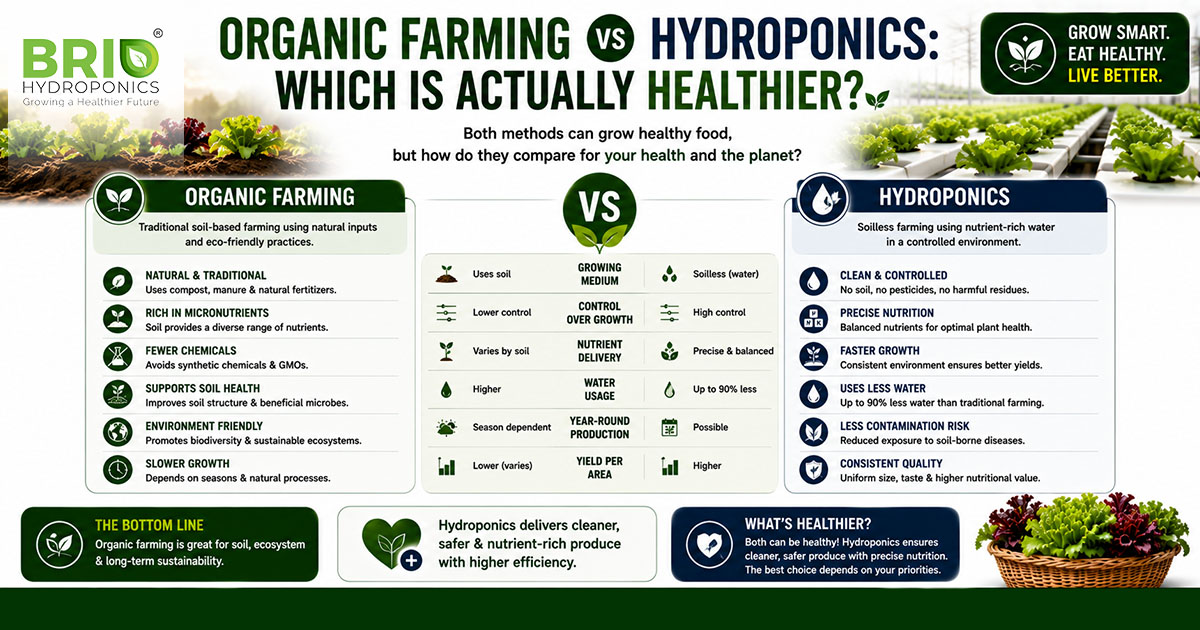
Here is how the two methods stack up across the factors that actually affect food safety, nutrition and sustainability.
| Factor | Organic Farming | Hydroponics |
|---|---|---|
| Growing medium | Soil, enriched with compost and natural amendments | Water based nutrient solution, no soil involved |
| Nutrient source | Compost, manure, natural amendments broken down by soil organisms | Precisely mixed mineral nutrient solution controlled by the grower |
| Pesticide use | Natural or biological pesticides permitted, synthetic ones banned | Typically pesticide free by design, since it is grown in a controlled, enclosed environment |
| Certification available in India | Yes, through NPOP and India Organic or PGS-India certification | No formal hydroponic certification exists in India yet, and hydroponic produce generally cannot be labelled organic |
| Water use | Higher, since water spreads through open soil and evaporates | Much lower, typically 70 to 90 percent less due to closed loop recirculation |
| Land dependency | High, needs fertile, well managed soil and adequate land area | Low, can be grown on non-arable land, rooftops or indoor spaces |
| Weather dependency | Significant, yields shift with rainfall, temperature and season | Minimal, protected structures allow year-round, consistent production |
| Growth speed | Slower, tied to natural soil and seasonal cycles | Faster, controlled nutrients and environment speed up growth cycles |
| Risk of contamination | Present if manure or compost is not properly treated | Low, since there is no soil borne pathogen exposure |
| Typical crops | Wide range including grains, pulses, fruits and vegetables | Best suited to leafy greens, herbs and select fruiting vegetables |
Which Is Actually Safer to Eat?
This is where the comparison gets genuinely interesting, because the popular assumption that organic automatically means safer does not hold up as cleanly as most people think. Organic farming still uses manure and compost as fertiliser, and if these are not properly treated and composted, they carry a real risk of bacterial contamination, including E. coli and salmonella, both of which have been linked to organic produce recalls in various markets over the years. Organic farming also still permits certain natural pesticides, which are not automatically harmless simply because they are derived from plants or minerals rather than synthetic chemistry.
Hydroponic systems, by contrast, operate in a controlled, enclosed environment with no soil, which removes the entire pathway for soil borne pathogens and most manure related contamination risks. Since nutrients are delivered through a precisely mixed mineral solution rather than decomposing organic matter, the risk profile shifts considerably. Most commercial hydroponic operations, especially in India where produce is often targeted at premium retail, hotels and export markets, are also grown without any pesticide use at all, since pest pressure is naturally lower in an enclosed structure.
None of this means organic farming is unsafe. Well managed organic farms with properly treated compost and careful hygiene practices produce genuinely clean, healthy food. The point is simply that the word organic is not, by itself, a guarantee of lower contamination risk, and hydroponic produce should not be dismissed as less safe just because it lacks the organic label.
Nutrition: Does Soil Actually Make Food More Nutritious?
This is one of the most debated questions in the entire organic versus hydroponic conversation, and honestly, the science is not fully settled either way. Organic farming advocates argue that soil grown produce develops richer flavour and nutrient density through natural interaction with soil microbes and minerals over a longer growing cycle. Hydroponic advocates point to studies showing that precise nutrient dosing can actually increase certain nutrients and beneficial compounds, since the plant is never left wanting for anything it needs at any growth stage.
What can be said with more confidence is that nutrient content in both methods depends heavily on how well the system is managed, not on the method itself in isolation. A poorly managed organic farm with depleted soil can produce less nutritious food than a well run hydroponic setup, and the reverse is equally true. Freshness plays a bigger role than most people assume too, since hydroponic farms are frequently located close to urban consumption centres, which shortens the time between harvest and plate, a factor that genuinely does affect nutrient retention regardless of growing method.
Sustainability: Water, Land and Environmental Impact
On resource efficiency, hydroponics has a clear practical edge, particularly in a water stressed country like India. Because hydroponic systems recirculate water in a closed loop rather than letting it soak into open soil or evaporate off exposed fields, water use typically drops by 70 to 90 percent compared to conventional or organic soil based farming for the same crop volume. Hydroponics also does not require fertile land, which means it can be set up on rooftops, in warehouses, or on land that would otherwise be unsuitable for traditional cultivation.
Organic farming holds its own advantage here too, though a different kind. By actively building soil health, encouraging biodiversity and avoiding synthetic inputs entirely, organic farming supports a broader ecological balance that hydroponics, being a fully engineered system, does not directly address. Soil carbon sequestration, pollinator support and long term land regeneration are real environmental benefits that organic practices contribute to, and these matter for the planet even if they do not show up on a nutrition label.
Where Protected Cultivation Fits Into the Picture
Protected cultivation is the umbrella term the Indian government uses for growing methods that shield crops from open field risks, weather, pests, and unpredictable soil conditions, using structures like polyhouses, shade net houses and hydroponic systems. This is one of the fastest growing categories of modern farming techniques in India, actively backed by subsidy support through the National Horticulture Board and the Mission for Integrated Development of Horticulture, since it directly supports the government's goals around reducing crop failure risk and improving farmer income stability.
Hydroponics sits squarely within this protected cultivation category, and this is precisely why it is often grouped together with polyhouse and greenhouse farming in government policy discussions, even though hydroponics itself refers specifically to the soilless growing technique rather than the structure around it. Organic farming, by comparison, is almost always practiced in open field conditions, which is part of why it remains more exposed to the very weather and pest risks that protected cultivation methods are designed to reduce.
Cost and Time to Market: A Practical Comparison
Setup cost and the time it takes to actually start earning from the farm differ significantly between the two approaches, and this is often the deciding factor for anyone evaluating this as a business rather than a lifestyle choice.
| Method | Approximate Setup Cost | Typical Time to Market Ready Produce |
|---|---|---|
| Organic Farming (open field, per acre) | Roughly Rs 1 lakh to Rs 5 lakh depending on land prep and certification | 3 to 5 years to achieve full certified organic status |
| Hydroponic Farming (per 1,000 sq ft) | Roughly Rs 5 lakh to Rs 20 lakh depending on system and automation | 3 to 6 weeks for leafy greens, longer for fruiting crops |
These are general market ranges for commercial projects in 2026 and vary based on scale, automation level, region and crop selection.
Organic farming generally has a lower entry cost, but the multi-year conversion period required for certification means it takes considerably longer to reach a point where produce can be sold under the certified organic label at a premium price. Hydroponics carries a higher upfront investment, largely due to the structure, pumps and monitoring equipment involved, but growers can typically start harvesting and selling within weeks for leafy greens, which means cash flow returns much faster, even without an organic certification to lean on.
Why the Labelling Confusion Keeps Happening
Part of the reason this question keeps coming up is that both organic and hydroponic marketing lean on similar language, words like natural, pesticide free, chemical free and clean, without always explaining what those words legally mean. A shopper reading pesticide free on a hydroponic pack and organic on another pack next to it can reasonably assume they are being offered two versions of the same promise. In reality, one is a certified legal claim backed by a multi-year inspection process, and the other is a factual description of growing conditions that has not gone through that same certification pathway.
This is not a case of one label being more honest than the other. Both can be entirely truthful. It simply means the terms are answering different questions, organic certification tells you how the land was managed over time, while hydroponic labelling tells you how the plant was fed and in what kind of environment it grew. Understanding that difference helps both growers market their produce accurately and helps shoppers make a more informed choice rather than assuming the two labels are interchangeable.
Which One Should You Choose?
Choose Organic Farming If
- You have access to fertile agricultural land and are comfortable with a multi-year path to certification
- You want to grow a wide range of crops including grains, pulses and orchard produce
- You value soil regeneration, biodiversity and long term ecological benefits as part of your farming philosophy
- You are targeting a market segment specifically looking for certified organic labelling
Choose Hydroponics If
- You have limited or no access to fertile land, including rooftop, urban or non-arable spaces
- You want faster time to market and quicker cash flow, especially with leafy greens and herbs
- You want precise control over nutrients, water use and growing conditions regardless of season
- You are targeting premium retail, hotels or export markets that value pesticide free, consistently high quality produce, even without an organic label
Why Not Both
A growing number of Indian agri-entrepreneurs are not choosing one over the other but building both into the same broader farming business. It is increasingly common to see hydroponic units for fast cycling leafy greens running alongside certified organic plots for grains, pulses or orchard crops, giving the operation multiple revenue streams and reduced dependence on any single market segment or growing method.
FAQs on Organic Farming vs Hydroponics
Is hydroponic food organic?
No. Organic certification in India, through NPOP or PGS-India, is built around soil management practices, and since hydroponics removes soil entirely, hydroponically grown produce cannot legally be labelled organic, even if it is grown without pesticides.
Is hydroponic food healthier than organic food?
Neither is universally healthier. Hydroponic produce tends to have lower contamination risk since there is no soil or manure involved, while organic farming supports broader ecological benefits like soil health and biodiversity. Actual nutrition depends heavily on how well each system is managed rather than the method alone.
What is the difference between traditional farming and modern farming techniques like hydroponics?
Traditional farming relies on open soil, seasonal cycles and natural rainfall, which makes yields unpredictable and weather dependent. Modern farming techniques like hydroponics and protected cultivation use controlled environments, precise nutrient delivery and recirculated water, allowing consistent, year-round production regardless of outside weather conditions.
What is protected cultivation in Indian agriculture?
Protected cultivation refers to growing crops inside structures like polyhouses, shade net houses and greenhouses, including hydroponic and soilless farming systems, that shield crops from unpredictable weather, pests and disease. It is actively supported through government subsidy schemes under the National Horticulture Board and MIDH.
Can hydroponic farms get any kind of certification in India?
There is currently no dedicated national certification specifically for hydroponic produce in India, unlike the established NPOP framework for organic farming. Some hydroponic growers pursue food safety certifications like FSSAI compliance or GAP standards to demonstrate quality and safety to buyers, but these are not equivalent to an organic label.
Does hydroponic farming use pesticides?
Most commercial hydroponic operations use little to no pesticide, since growing in an enclosed, controlled environment naturally reduces pest pressure compared to open field farming. When pest issues do arise, growers typically rely on biological controls rather than chemical pesticides to protect the pesticide free positioning of their produce.
Is soilless farming in India growing in popularity?
Yes, soilless farming, including hydroponics and other protected cultivation methods, is one of the fastest growing segments in Indian agriculture, driven by rising urban demand for pesticide free produce, shrinking arable land, and increasing government support through horticulture subsidy schemes.
Which method is more profitable, organic farming or hydroponics?
Hydroponics generally reaches profitability faster due to shorter crop cycles and quicker cash flow, particularly for leafy greens. Organic farming can be highly profitable too, especially once certification is achieved and premium organic pricing kicks in, but it typically takes longer, given the multi-year conversion period required before land can be certified.
Curious Which Farming Method Suits Your Goals?
Whether you are drawn to certified organic farming or want the speed and control that hydroponics offers, the right choice depends on your land, budget and target market. Brio Hydroponics has helped businessmen, land owners and agripreneurs across India set up commercially viable hydroponic and protected cultivation projects, matched to their specific goals and crop plans. Talk to our team before you decide on your farming approach.