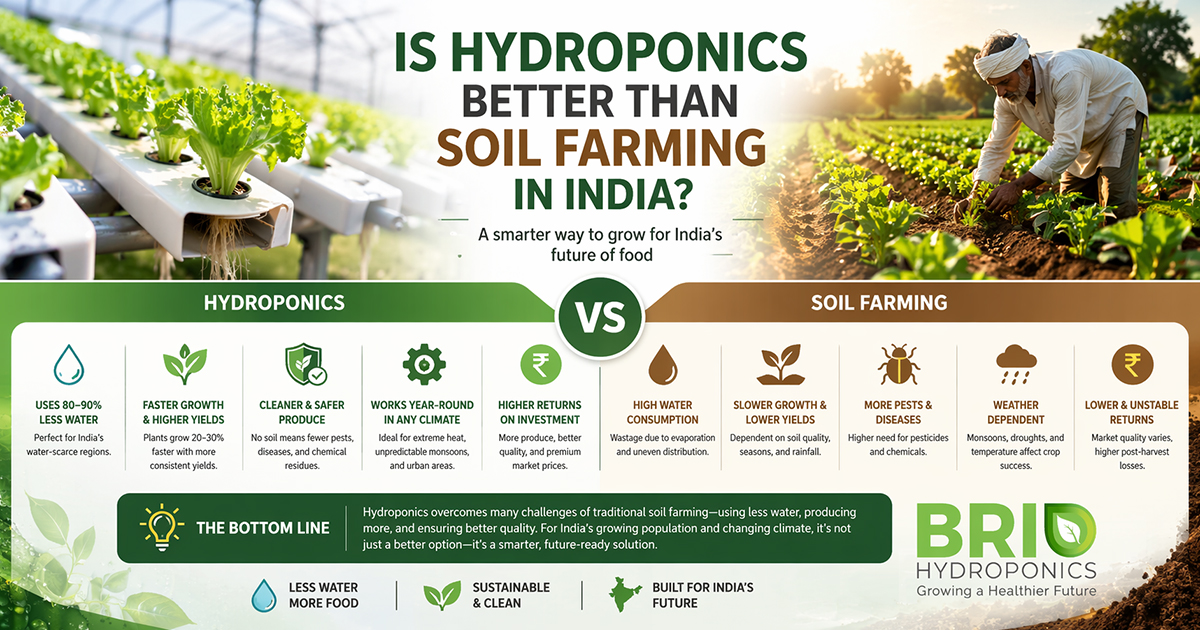
Agriculture has always been the backbone of food production, but the methods used to grow crops have changed over time. Today, the comparison between hydroponics vs traditional farming is becoming more relevant as farmers and entrepreneurs look for better productivity, quality, and profitability.
Both systems have their strengths, but they work in completely different ways. Soil farming depends on natural conditions like land quality, weather, and rainfall, while hydroponics is a controlled method where plants grow without soil using nutrient-rich water.
To understand which method works better, it is important to look at how each system functions, their benefits, limitations, and long-term outcomes.
Understanding Soil Farming
Soil farming is the conventional method of agriculture where crops are grown in natural soil. Plants absorb nutrients from the soil, which may vary depending on fertility, organic content, and environmental conditions.
Farmers depend on:
- Rainfall or irrigation
- Soil fertility
- Seasonal cycles
- Natural sunlight
While this method has been used for generations, it comes with challenges such as soil degradation, pest attacks, and inconsistent yields.
Understanding Hydroponics Farming
Hydroponics is a modern approach where plants are grown in a controlled environment without soil. Instead, nutrients are supplied directly through water.
In soil vs hydroponics farming, the key difference lies in how plants receive nutrients:
- Soil farming: Nutrients come from soil
- Hydroponics farming: Nutrients come from a water-based solution
Hydroponics removes dependency on soil quality and allows better control over plant growth.
Difference Between Traditional Farming and Modern Farming
The difference between traditional farming and modern farming can be clearly understood by comparing key factors:
1. Growing Medium
- Traditional farming: Soil
- Modern hydroponics: Water + growing medium
2. Nutrient Delivery
- Traditional: Indirect and dependent on soil quality
- Hydroponics: Direct and controlled
3. Water Usage
- Traditional: High water consumption with wastage
- Hydroponics: Uses significantly less water through recycling
4. Space Requirement
- Traditional: Requires large land areas
- Hydroponics: Can be done in compact or vertical spaces
5. Crop Growth Speed
- Traditional: Slower due to natural limitations
- Hydroponics: Faster growth due to direct nutrient supply
6. Environmental Control
- Traditional: Dependent on weather
- Hydroponics: Fully controlled environment
Hydroponics vs Traditional Farming
When comparing hydroponics vs traditional farming, several important factors come into play:
Productivity
Hydroponics allows plants to grow faster because nutrients are readily available. In traditional farming, plants spend energy searching for nutrients in the soil.
Consistency
Hydroponics offers uniform crop quality because environmental conditions are controlled. Traditional farming often produces variable results due to climate changes.
Resource Efficiency
Hydroponics uses:
- Less water
- Less space
- Fewer chemicals
Traditional farming often involves higher input costs for water, fertilisers, and pesticides.
Hydroponics vs Soil Farming Yield Comparison
One of the most important aspects is yield.
In a hydroponics vs soil farming yield comparison:
- Hydroponics can produce 2–3 times more yield in the same space
- Multiple crop cycles are possible in a year
- Crop losses are lower due to controlled conditions
In soil farming:
- Yield depends on season and soil quality
- Crop failure risk is higher
- Productivity per acre is lower compared to hydroponics
This makes hydroponics more suitable for high-density farming.
Hydroponic Farming Benefits
There are several hydroponic farming benefits that make it attractive:
1. Faster Growth Rate
Plants grow 30–50% faster because nutrients are directly absorbed.
2. Water Efficiency
Hydroponics uses up to 80–90% less water compared to soil farming.
3. Higher Yield
More crops can be grown in less space with better output.
4. Less Pest and Disease Issues
No soil means fewer soil-borne diseases.
5. Better Quality Produce
Crops are cleaner, fresher, and more uniform.
6. Year-Round Farming
Production is not limited by seasons.
Advantages of Hydroponics Over Traditional Farming
The advantages of hydroponics over traditional farming include:
Controlled Environment
Temperature, humidity, and nutrients can be managed precisely.
Reduced Labour
Automation reduces manual labour compared to field farming.
Efficient Land Use
Vertical systems allow more production in smaller areas.
Lower Chemical Usage
Minimal pesticides and herbicides are required.
Scalability
Hydroponics can be expanded easily based on demand.
Limitations of Hydroponics
Despite its advantages, hydroponics has some limitations:
High Initial Investment
Setting up infrastructure like pumps, pipes, and greenhouse systems requires capital.
Technical Knowledge
Farmers need training to manage nutrients, pH, and systems.
Power Dependency
Electricity is required for pumps and lighting.
Maintenance Requirement
Regular monitoring is essential to avoid system failures.
Limitations of Traditional Soil Farming
Traditional farming also faces several issues:
Soil Degradation
Continuous farming reduces soil fertility over time.
Water Wastage
Irrigation methods often lead to water loss.
Pest and Disease Problems
Soil-borne diseases can damage crops.
Weather Dependency
Rainfall and climate changes directly affect yield.
Modern Farming Techniques
Hydroponics is part of modern farming techniques, which aim to improve efficiency and productivity. Other modern methods include:
- Drip irrigation
- Precision farming
- Vertical farming
- Greenhouse cultivation
These methods focus on better resource management and higher output.
Which Farming Method is More Profitable?
A key question is: which farming method is more profitable?
Hydroponics Profitability
Hydroponics offers:
- Higher yield per square foot
- Premium pricing for quality produce
- Faster crop cycles
- Year-round income
However, profitability depends on:
- Proper setup
- Market demand
- Operational efficiency
Traditional Farming Profitability
Traditional farming:
- Has lower initial investment
- Is easier to start
- Depends heavily on external factors
Profit margins can fluctuate due to:
- Weather conditions
- Market price variations
- Crop failures
Final Comparison on Profitability
- Short term: Traditional farming may seem easier due to lower cost
- Long term: Hydroponics can generate higher and more stable returns
Soil vs Hydroponics Farming: A Practical Comparison
| Factor | Soil Farming | Hydroponics Farming |
| Medium | Soil | Water-based |
| Water Usage | High | Low |
| Yield | Moderate | High |
| Growth Speed | Slower | Faster |
| Pest Issues | High | Low |
| Space Requirement | Large | Compact |
| Investment | Low | High |
| Control | Limited | High |
Choosing the Right Farming Method
The choice between hydroponics and soil farming depends on:
- Budget
- Available space
- Technical knowledge
- Market access
- Crop type
Hydroponics is suitable for:
- Commercial vegetable production
- Urban farming setups
- High-value crops
Traditional farming is suitable for:
- Large-scale rural agriculture
- Staple crops like wheat and rice
Conclusion
The debate of hydroponics vs traditional farming is not about replacing one with the other, but about choosing the right method based on needs and resources.
Hydroponics stands out as a modern and efficient solution, offering higher yields, better quality, and controlled farming conditions. On the other hand, traditional soil farming continues to play an important role in large-scale agriculture.
When comparing soil vs hydroponics farming, hydroponics clearly offers advantages in productivity, resource efficiency, and consistency. For those looking at long-term growth and profitability, hydroponics farming presents a strong opportunity.
Understanding the difference between traditional farming and modern farming helps in making informed decisions and adopting the right approach for sustainable agriculture.