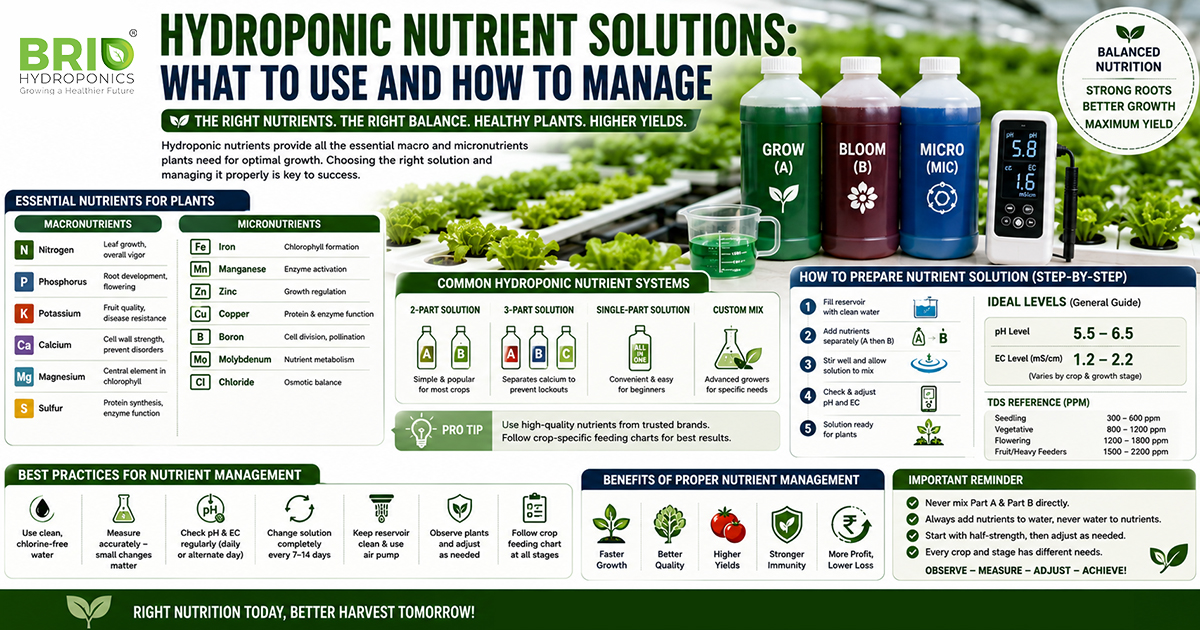
In hydroponics, plants do not get any nutrition from soil. Every element the plant needs must come from the water it absorbs. This is why understanding hydroponic nutrient solutions is not optional. It is the most critical part of running a successful soilless farm.
Getting nutrients right means healthy plants, high yields, and fewer crop failures. Getting it wrong leads to deficiencies, root rot, and crop loss. In this blog, we break down everything you need to know about nutrient solution for hydroponics in a simple, easy-to-understand format designed for Indian farmers and growers.
Why Nutrient Solution Matters in Hydroponics
In traditional farming, soil acts as a reservoir of nutrients. In hydroponics, your nutrient solution does that same job. It must supply all the elements a plant needs in the right concentrations and the right balance.
The quality of your nutrient solution directly affects plant growth rate, leaf colour, fruit size, and crop yield. Consistent monitoring and management of your hydroponic fertilizer solution is what separates a profitable farm from one that struggles.
Hydroponic Nutrients List: What Plants Actually Need
The hydroponic nutrients list includes two main categories: macronutrients and micronutrients.
Macronutrients (Needed in Large Quantities)
- Nitrogen (N): Essential for leaf and stem growth. Plants with nitrogen deficiency show yellowing of older leaves
- Phosphorus (P): Needed for root development and flowering. Low phosphorus causes purple discolouration of leaves
- Potassium (K): Regulates water movement and improves fruit quality. Deficiency shows as brown leaf edges
- Calcium (Ca): Strengthens cell walls. Deficiency causes tip burn in lettuce and blossom end rot in tomatoes
- Magnesium (Mg): Part of chlorophyll. Deficiency causes yellowing between leaf veins
- Sulphur (S): Needed for protein synthesis. Deficiency shows as pale yellowing in younger leaves
Micronutrients (Needed in Small Quantities)
Even though micronutrients are needed in trace amounts, their absence causes serious problems. The key micronutrients include Iron, Manganese, Zinc, Boron, Copper, Molybdenum, and Chlorine. A good quality hydroponic fertilizer formulation includes all of these in the correct ratio.
How to Prepare Nutrient Solution for Hydroponics
How to prepare nutrient solution for hydroponics is a step-by-step process that any grower can master with a bit of practice.
Step 1: Start with Clean Water
Use clean, good-quality water. Ideally, the source water should have a TDS (Total Dissolved Solids) below 200 ppm. If your water is hard or alkaline, use RO (Reverse Osmosis) filtered water. Hard water can interfere with nutrient uptake and block the absorption of key elements.
Step 2: Measure Water Volume
Know how many litres of water you are preparing the solution for. Most nutrient formulations are listed in grams or millilitres per litre of water. Getting the volume right ensures accurate dosing.
Step 3: Add Nutrients in Correct Order
Add Part A nutrients first (usually calcium-based), stir well, then add Part B nutrients (usually containing phosphorus and other elements). Never mix Part A and Part B concentrates directly together as they can react and precipitate.
Step 4: Check EC and pH
After mixing, check EC and pH in hydroponics with reliable meters. Adjust pH using pH Up (potassium hydroxide) or pH Down (phosphoric or nitric acid). Allow the solution to stabilise for a few minutes before final reading.
Step 5: Monitor and Top Up
As plants absorb water and nutrients, the reservoir level drops and nutrient balance shifts. Top up with fresh water and small doses of nutrients as needed. Full nutrient solution change should be done every 7 to 10 days.
Managing pH and EC in Hydroponics
Managing pH and EC in hydroponics is a daily task that cannot be ignored. These two parameters determine whether your plants can actually absorb the nutrients you have provided.
Understanding pH
pH measures how acidic or alkaline your nutrient solution is. The ideal pH range for most hydroponic crops is between 5.5 and 6.5. Outside this range, certain nutrients become locked out, meaning plants cannot absorb them even if they are present in the water.
- Too low pH (below 5.5): Iron, manganese toxicity risk; calcium and magnesium lockout
- Too high pH (above 6.8): Iron, zinc, manganese become unavailable to plants
Understanding EC (Electrical Conductivity)
EC measures the total concentration of dissolved minerals in your solution. Higher EC means more nutrients dissolved. The right EC depends on the crop and growth stage.
Hydroponic Nutrient Chart: EC Ranges by Crop
|
Crop |
Seedling EC |
Veg / Growth EC |
Fruiting EC |
|
Lettuce |
0.8 - 1.2 |
1.2 - 2.0 |
N/A |
|
Tomato |
1.0 - 1.5 |
2.0 - 3.5 |
3.0 - 4.5 |
|
Cucumber |
1.0 - 1.5 |
1.8 - 2.5 |
2.5 - 3.5 |
|
Capsicum |
1.0 - 1.5 |
2.0 - 3.0 |
2.5 - 3.5 |
|
Herbs |
0.8 - 1.2 |
1.0 - 1.8 |
N/A |
Best Nutrients for Hydroponic Plants
Choosing the best nutrients for hydroponic plants is important. There are two main types of formulations available in India:
-
Two-Part Formulations: Most commonly used commercially. Part A contains calcium and nitrogen; Part B contains phosphorus, potassium, and micronutrients. Mixed separately in water before use.
- Three-Part Formulations: Allows more flexibility at different growth stages. Ideal for commercial growers managing multiple crops.
- Ready-Mix Powders: Available as a single powder for general use. Good for beginners but less flexible for crop-specific adjustments.
Common Nutrient Problems and Solutions
-
Yellow leaves: Check nitrogen levels and pH. Low nitrogen or high pH can both cause yellowing
-
Brown leaf tips: Could indicate potassium deficiency or excess EC in the reservoir
- Wilting despite water: Could be calcium deficiency or root rot caused by waterlogging
- Pale green new leaves: Iron deficiency usually linked to high pH. Lower pH to improve iron availability
- Slow growth: Low EC or imbalanced nutrient ratio. Verify your formulation and check meters for calibration
Get Your Nutrient Management Right from Day One
Nutrient management is the backbone of a successful hydroponic farm. Whether you are growing lettuce, tomatoes, or herbs, understanding your hydroponic nutrient solutions and keeping EC and pH in check is what keeps your crops thriving.
Speak to our agronomy team today for personalised nutrient recommendations for your crop, system, and water quality. We provide nutrient charts, water testing support, and on-farm guidance for growers across India.
Build your farm on solid nutrition. Healthy nutrients mean healthy plants and better harvests.
Frequently Asked Questions (FAQs)
Q1. What is the ideal pH for hydroponic nutrient solution?
The ideal pH range for most hydroponic crops is between 5.5 and 6.5. Lettuce and leafy greens prefer 5.5 to 6.2, while fruiting crops like tomatoes do well at 5.8 to 6.5.
Q2. How often should I change the nutrient solution?
In most systems, a full solution change every 7 to 10 days is recommended. In between changes, top up with fresh water and add small amounts of nutrients to maintain EC levels.
Q3. Can I make my own hydroponic nutrient solution at home?
Yes, you can prepare nutrient solutions using food-grade fertiliser salts. However, this requires knowledge of salt solubility and careful weighing. For beginners, it is easier and safer to start with a ready-made two-part or three-part nutrient formulation.
Q4. What EC level is best for lettuce in hydroponics?
Lettuce grows best at an EC of 1.2 to 2.0 mS/cm during the main growing period. During seedling stage, keep it lower at 0.8 to 1.2 to avoid salt stress on young roots.
Q5. What happens if EC is too high in hydroponics?
High EC creates salt stress on roots, causing water uptake to slow down. Plants may wilt, develop brown leaf tips, and show reduced growth. Dilute the solution by adding fresh water to bring EC back to the target range.
Q6. Where can I buy hydroponic nutrients in India?
Hydroponic nutrient solutions are available from hydroponic supply companies, agri-input dealers, and online platforms. Always choose suppliers who provide complete formulations with both macro and micronutrients included.
Q7. Do I need separate nutrients for different crops?
Yes, ideally. Leafy crops like lettuce need a different nutrient ratio than fruiting crops like tomatoes or cucumbers. Using a crop-specific nutrient chart and formulation will give you much better results than a one-size-fits-all approach.